Choosing a domain name for your startup is hard—I’ve been there. When I launched my previous company, Monograph, a project management software for A&E firms, we went with monograph.io because the .com wasn't available and we had a company to build. The .com came later, after we had traction.
That experience raised a broader question: how are founders actually approaching domain naming today? To find out, we analyzed over 5,500 startups from the Y Combinator (YC) accelerator program to see what founders are actually doing when it comes to domains.
This analysis looks at startup domain naming trends across top-level domains (TLDs,) brandable vs. keyword strategies, name length, and structural naming patterns. A few things immediately jumped out:
- .com is in decline. Usage has dropped from 100% to 46% over the past 20 years. It's still the most popular option, but it's no longer the default.
- .ai is on fire. It's now the second-most-popular TLD among recent YC companies, overtaking .io.
- Brandable names win. 87% of YC companies chose brandable names over purely keyword-based ones—and that ratio has held steady even as TLD preferences shifted dramatically underneath it.
That last point is the one worth paying attention to. The .com vs .ai vs .io debate gets a lot of airtime, especially from first-time founders. But the data suggests the extension matters far less than the name itself.
How startup TLD choices have changed over 20 years
Top-level domain preferences among startups have shifted from near-universal .com adoption toward diversification across .ai, .io, and niche extensions.
For the first few years of YC, there was no TLD decision to make. From 2005 through about 2008, almost every company used a .com. The handful that didn’t were outliers, a stray .org or country-code domain, not a trend.
2009 marked the rise of .io and .co, with developer focused products favoring .io, while .co perhaps was seen as a cheaper .com replacement. By the mid-2010s, .io had become the unofficial “I couldn’t get the .com” TLD, peaking at around 9.5% of YC companies in 2020.
Then the .ai goldrush began
Starting around 2022, .ai went from a novelty to the second-most-popular TLD in the dataset—roughly 30% of recent batches. It essentially ate .io’s share, which dropped back to about 3.5%. But unlike .io, founders aren’t choosing .ai because the .com is taken. They’re choosing it because it signals what they build.
Meanwhile, .com has settled into a new normal. After nearly twenty years of steady decline, it stabilized around 46%—still the most popular TLD by a wide margin, but no longer the default. If you’ve seen the “death of .com” hot-takes that pop up every couple years, the data doesn’t support them.
There’s one more trend worth noting: fragmentation. The “other” bucket in the chart above (everything beyond .com, .ai, .io, and .co) now makes up roughly 18% of YC domains. Across the full dataset we found 135 unique extensions. Most of them (like .dev, .app, .so, and .bio) never individually broke out, but collectively they’re a real chunk.
Current startup domain trends
The 20-year trend is useful context, but if you’re choosing a domain today, what matters is what the landscape looks like right now. Here’s the breakdown across three time windows:
In 2025 alone, .com accounted for 46% of YC domains and .ai hit 31% — nearly one in three startups. Together they make up over three-quarters of all domain choices. After that it drops off fast: .dev (3.8%), .io (3.5%), and .co (2.1%) round out the top five, with everything else under 2%.
The three-window view shows how quickly this is shifting. .io sat at 6% across the five-year view but has dropped to 3.5% in 2025. .co has fallen from nearly 5% to 2%. Meanwhile .dev has quietly overtaken both of them in 2025 — a small number, but a notable shift for an extension that barely existed a few years ago.
The practical read: if you’re building in AI, .ai is now a mainstream choice — not an alternative, not a compromise. If you’re not, .com is still the safe pick, with .dev, .io, and .co as reasonable runners-up. Beyond the top five, you’re into true long-tail territory where you’ll likely spend more time explaining your TLD than benefiting from it.
Do successful startups upgrade to .com later?
The conventional wisdom says something like: launch on whatever TLD you can get, then upgrade to .com once you have traction. That was our path at Monograph (.io → .com), and I figured it was common. However, the data paints a slightly different picture.
Within each cohort, the .com rate among active companies is nearly identical to the overall rate. In the 2016–2020 group, 68% of all companies used .com and 70% of active ones did. In the 2021–2025 group, it’s 51% across the board. Founders are mostly keeping whatever TLD they started with and it doesn’t seem to be holding them back.
The takeaway: your TLD probably matters less than you think. The data doesn’t support the idea that you need to “upgrade” to .com to succeed. If you launch on .ai or .io and the business works, you’ll likely stay there—and that’s fine.
Beyond TLDs: length and naming patterns
The TLD debate gets all the attention, but honestly, the more useful findings are in the names themselves.
How long should your domain be?
The median domain length across all 5,500 YC companies is 8 characters (excluding the TLD). The distribution is a clean bell curve peaking right at that number, 7 and 8 character names are the most common, and the sweet spot of 6–10 characters accounts for about 65% of all domains in the dataset.
On the extremes, a couple of domains are just 1–2 characters (0.email, x1.new)—good luck finding one of those available—and a handful stretch past 20. But 95% of YC domains are 13 characters or shorter.
If you’re picking a domain right now, aim for under 10 characters. Short enough to remember, long enough to actually say something. This tracks with the advice in our guide on choosing a domain name: if you have to spell it out for someone, it’s probably too long.
Brandable domains win, and it’s not close
87% of YC companies use brandable names. Only about 13% go with keyword-based domains. That’s the most lopsided finding in the entire dataset, and it’s held steady even as everything else about domain choices has shifted dramatically over the past 20 years.
Here’s how all 5,500 names break down across the naming spectrum:
- Abstract (36%): real or invented words with no obvious connection to what the company does (Duffel, Velt, Karumi)
- Evocative (25%): real words that suggest a quality or concept related to the company’s mission (Conduit, Runway, Intellect)
- Descriptive (23%): name hints at what the product does without using literal industry keywords (SkillSync, ShipBob, Wagetap)
- Keyword (13%): contains direct industry or product-category terms (FinTool, CareRev, SalaryBook)
- Abbreviation (1.5%): acronyms or heavily shortened forms (GRU, D-ID)
- Exact match (0.2%): literal description of the service (BuyMeACoffee, BookMyFlight)
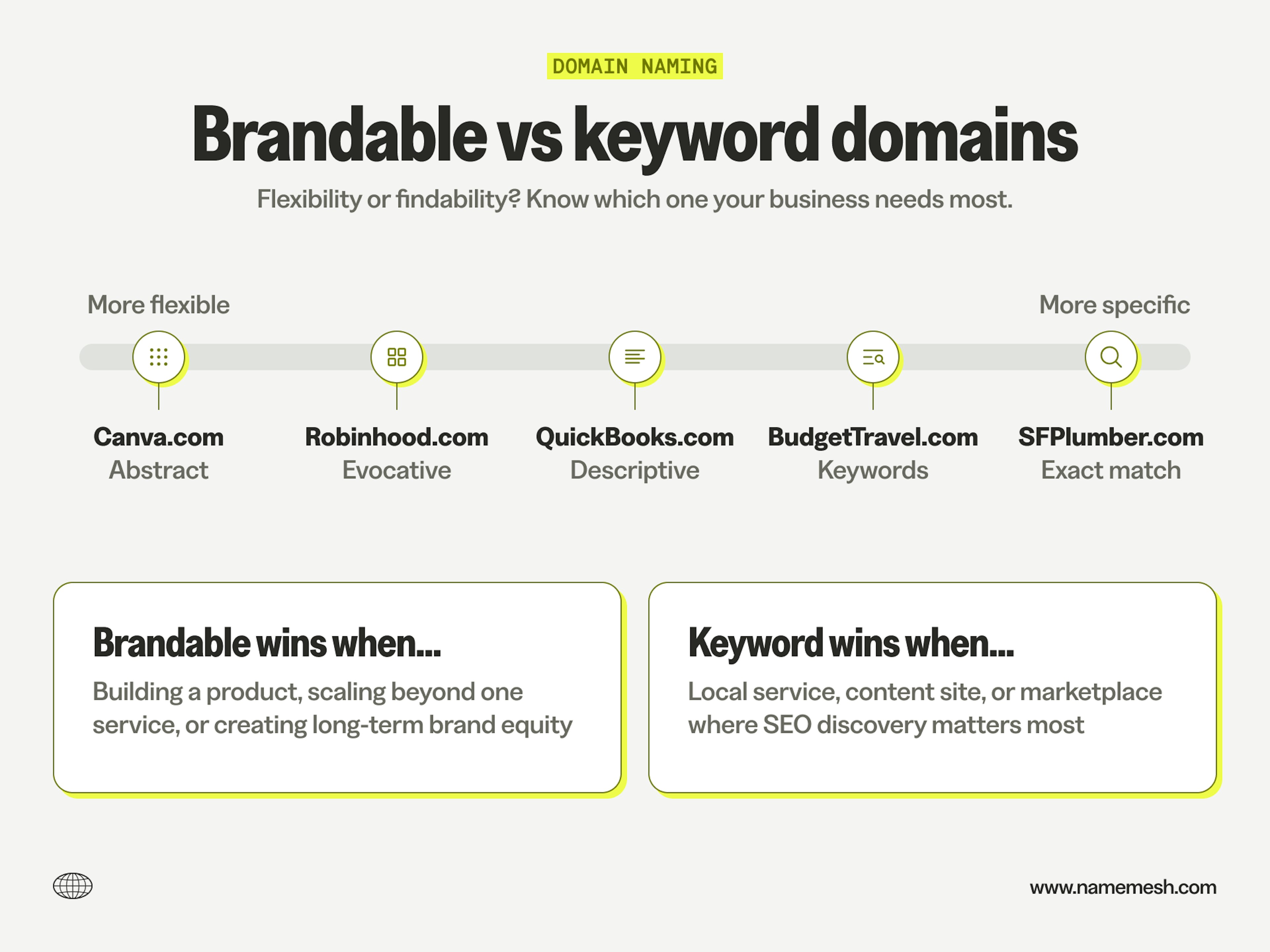
What stands out is how few founders go to either extreme. Nearly half of YC names fall in the evocative or descriptive middle—names that suggest what the company does without spelling it out literally. Pure keyword names and fully abstract names are both minority approaches.
How founders build their names
The naming spectrum tells you what YC founders are choosing. The formula data tells you how they’re constructing those names, and this is where it gets practical.
Single words are the most common approach at 38%, followed by compound words (two words stuck together) at 33%. Prefix/suffix constructions like Shopify or Postly account for 23%. Portmanteaus and verb-action names are rare, under 2% combined.
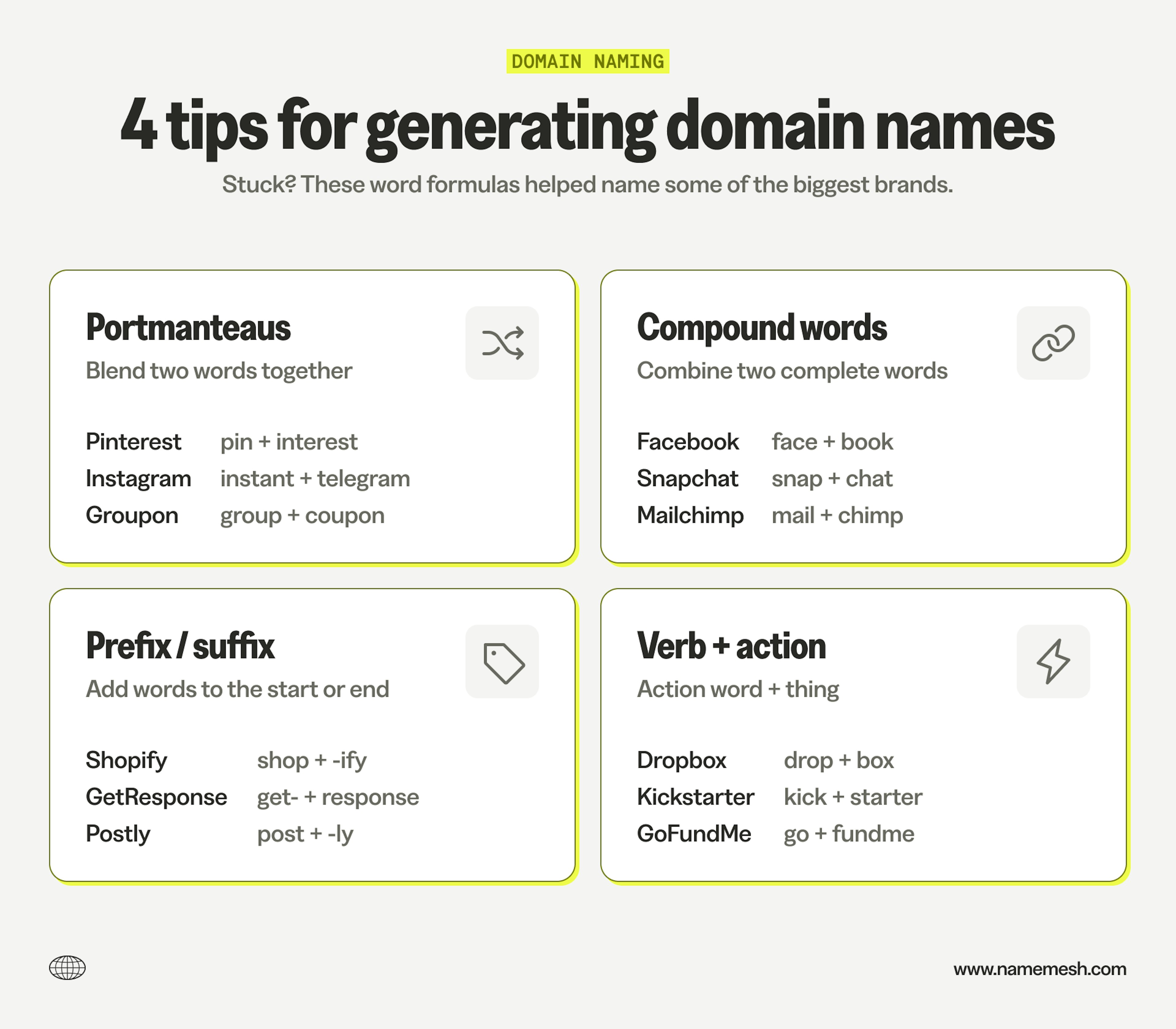
The prefix/suffix pattern is worth digging into, because it’s one of the easiest formulas to work with when your ideal name is taken. About 10% of YC domains use a prefix—a word tacked onto the front, usually to secure availability. The most common ones won’t surprise you:
- get (31%) — GetDexter, GetNao, GetSwipe
- use (16%) — UseSieve, UseThirdChair
- try (15%) — TryLevel, TryQ2Q
- go, join, hey, my, run, hello round out the rest
On the suffix side, the patterns are more varied—133 unique suffixes across the dataset. The most popular ones signal what kind of company it is:
- labs (15%) — OlioLabs, ArrayLabs, NaoLabs
- ai (14%) — JanetAI, DynamoAI, HegelAI
- health (12%) — LoopHealth, CareHealth
- app, hq, bio, robotics, tech, ly fill out the long tail
Startup domain naming recommendations
- The name matters more than the extension. 87% of YC companies chose brandable names, and that ratio has barely budged in 20 years. Meanwhile TLD preferences have shifted dramatically.
- .com is the safe bet, not the only bet. It’s still the most popular choice at 46%, but nearly half of recent YC founders are launching on something else. Don’t let the lack of a .com stop you from starting.
- .ai is mainstream if you’re building in AI. Nearly 1 in 3 YC founders now choose it. No credibility penalty—it’s arguably expected (especially if you’re building AI tools).
- Aim for under 10 characters. The median YC domain is 8 characters. 95% are under 13. Keep it short enough to remember.
- Name taken? Add a prefix or suffix. Get, Use, and Try account for over 60% of domain prefixes in the dataset, and Labs, AI, and Health are the most common suffixes.
- Your TLD doesn’t predict your outcome. Active companies aren’t more likely to be on .com than their cohort average. Launch on what you can get and build the business.
Our methodology
This analysis covers approximately 5,500 companies from Y Combinator’s publicly available company directory, spanning Summer 2005 through Spring 2026. For each company we extracted the current domain, TLD, batch year, and status (active, acquired, or dead).
Name classifications (brandable vs keyword, naming spectrum, and formula) were generated using Claude’s API with rules-based prompting, then validated against a manual sample. They’re directional, not definitive—treat the percentages as strong estimates rather than exact counts.
A few limitations worth noting: we’re looking at current domains, not historical ones, so we can’t confirm whether companies migrated between TLDs. Company status may lag reality—a startup marked active could have quietly shut down. And the dataset skews toward US-based tech companies, which is worth keeping in mind if you’re in a different market.