In the guide to choosing a domain name, I mentioned this one of the biggest decisions you’ll make. That wasn’t hyperbole: get this wrong and you’re either stuck with a name that limits your business, or facing the painful (and expensive) process of rebranding later.
The decision comes down to two directions: keyword domains and brandable domains. A keyword domain includes search terms that describe a service or topic, like DenverPlumber.com. A brandable domain is distinctive and not tied directly to keywords, like Monday.com.
You’ll see advice from all over the internet that frames this as a clean binary, but it’s not. It’s more of a spectrum, with names like Dropbox and GoFundMe sitting somewhere in the middle. But you still need to lean one way to make the right choice for your business.
In our analysis of 5,500 Y Combinator (YC) startups, 87% chose brandable names—and that number has been climbing.
So how do you choose? This guide covers when each domain approach actually makes sense, what actually still works (it’s more nuanced than ‘keyword domains are dead’), and how to decide based on your specific situation.
Key takeaways
- Brandable domains prioritize memorability and flexibility
- Keyword domains prioritize descriptive search relevance
- Brandable domains scale better long term
- Keyword domains can still help local or functional discovery
The SEO reality check
For most of the internet’s history, search engines were how people found websites where the easiest way to rank was to match your domain to what people searched for. This led to keyword domains, sometimes called exact match domains (EMDs), where businesses chose names like DenverPlumber.com or BudgetTravel.com based on Google queries, and not strong branding.
Google cracked down on this in 2012, reducing the ranking boost that exact match domains once received. But keyword domains didn’t disappear, especially for local and service-based searches. Studies still show them ranking well despite having less authority than branded competitors. If you’re a locksmith in Austin, the keyword rich domain name of AustinLocksmith.com still gives you a real edge.
The catch? Most keyword domains rank only for that one exact term. As an SEO domain name strategy, their value is narrow unless supported by strong content and authority signals. You win the specific search but miss everything else.
There’s also a bigger shift happening. AI search—ChatGPT, Perplexity, Google’s AI Overviews—doesn’t scan for keywords in your domain. These tools generate answers and cite sources based on brand recognition and trust. When someone asks an AI “who’s a good plumber in Denver,” it’s looking for businesses it considers credible, not domains that match the query.
Keyword domains still work in narrow situations. But the window is shrinking at a rapid rate.
When keyword domains win
There are still a few cases where a keyword domain is the better play. They’re narrower than most people think, but they’re real.
Local service businesses.
Search engines still reward keyword relevance in local search results, especially the map listings that show up when someone searches "plumber near me." Just remember—a name like DenverPlumber.com locks you into Denver.
Content and affiliate sites.
BestHikingBoots.com, CheapFlights.com, plays where the domain is the value proposition. People are searching for a topic, not seeking out a brand, so a descriptive domain signals exactly what they’ll find before they click.
Marketplaces and directories.
When the category is the product, a keyword domain makes intuitive sense. Think Apartments.com or Cars.com—the aggregation of that type of thing is the value proposition.
Single-purpose tools.
When your website is the utility, a keyword domain doubles as the product description. Users search for the function, find you, and the domain reinforces itself every time they come back.
As an example, I own wordcounter.io, a tool that does exactly what the name says. Users search “word counter,” find it, and the domain sticks. I type “w” and my browser autofills the rest. The name is the product. On the flipside, however, if I wanted to turn it into a full writing suite, the domain would prove very hard to rebrand.
When brandable domains win
For most businesses, brandable is the right default. The primary advantage of brandable domains is long-term brand equity and flexibility across products, markets, and channels.
They give you room to grow (and to stick)
A brandable domain name doesn’t box you in to a service, location, or tool. Shopify started as a way to set up an online store and now does payments, shipping, lending, and point-of-sale. Canva began as a simple graphic design tool and expanded into presentations, websites, and video editing.
Let’s take a look back at our Rule #3 from the guide, How to choose a domain name.
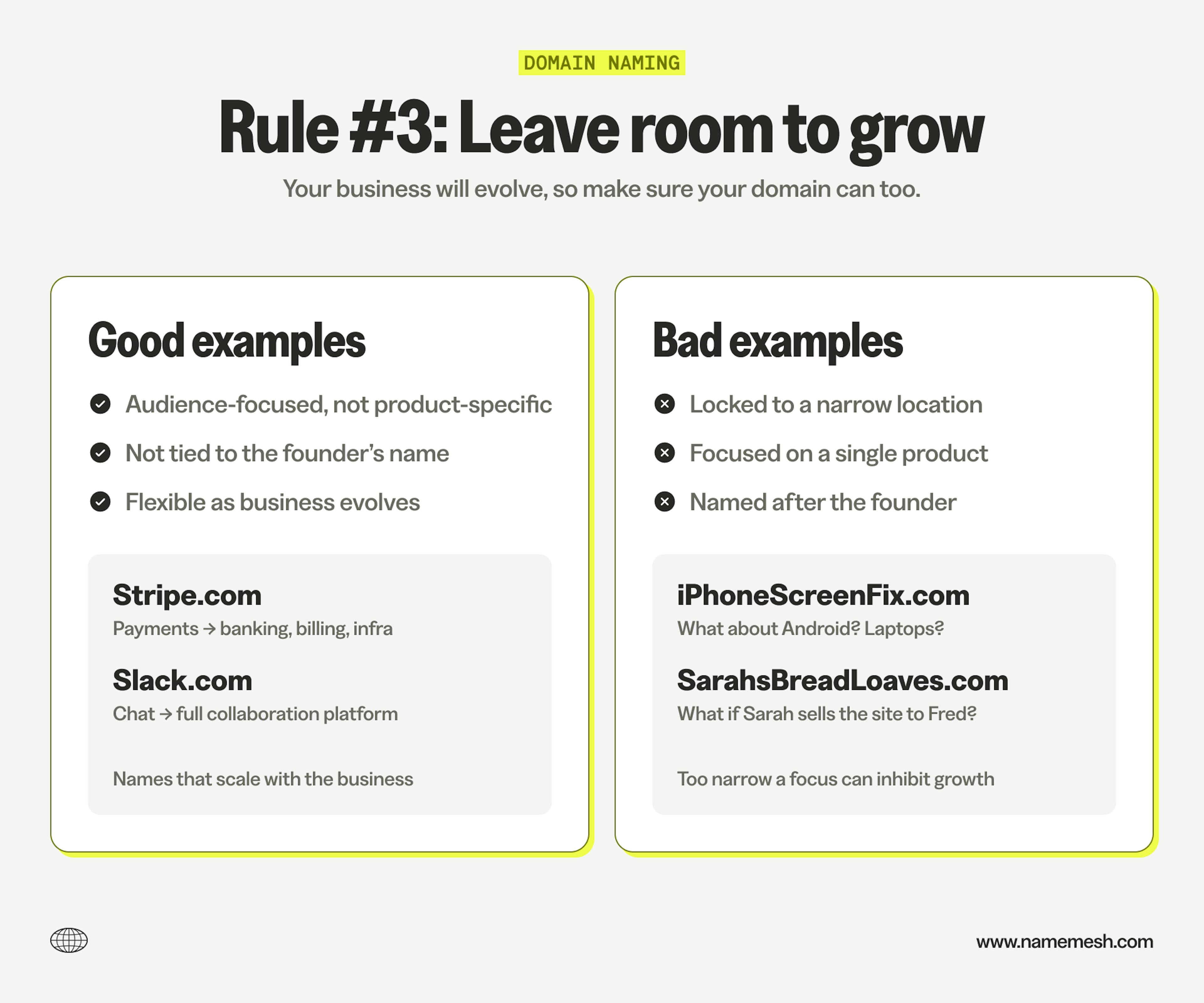
Flexibility only matters if people remember you in the first place. In a survey by Atom.com, 47% of consumers ranked memorability as the single most important characteristic of a domain name—ahead of simplicity, brand relevance, and yes, keywords.
Unique names stick in conversation, on a podcast, in a text to a friend. Nobody’s going to tell a colleague “you should check out BestOnlineGraphicDesignTool.com.” Say that outloud.
They’re easier to own
Brandable names are dramatically easier to trademark. Registering a generic term like “Hotels” or “Plumbing” is nearly impossible. They’re also more likely to be available as social handles across platforms, and you’re not competing with every other business in your space for the same obvious terms. This means brandable names tend to be more available and more affordable. A win win!
They’re where AI discovery is heading
As more people skip traditional search engines entirely and ask AI for answers, a recognizable brand becomes one of the few remaining moats. A distinct name that people and AI can both associate with your business is genuinely valuable—and one more reason to lean toward a brandable domain.
Comparison table: brandable vs keyword domains
| Brandable | Keyword | |
|---|---|---|
| Examples | AirBnB.com, Coinbase.com | Hotels.com, Crypto.com |
| Memorability | Unique, stands out in conversation | Descriptive, functional but forgettable |
| Expansion | Highly flexible | Category-locked |
| Trademark | Easier to register and defend | Often difficult or impossible |
| SEO | Build brand authority over time | Built-in keyword signal (declining advantage) |
| AI discoverability | Brand signals get cited | Generic, harder to associate with your business |
| Initial trust | Requires marketing investment | Instant category recognition |
| Availability | Easier to find, more affordable | Premium pricing, high competition |
The hybrid approach
While keyword only domains may be limiting, using keywords as part of a brandable name is a commonly overlooked middle ground, and you can see this at work in both startups and established businesses.
Take QuickBooks (or TurboTax): both names include a keyword derived from their product offering. “Books” is shorthand for the accounting ledger, and “Tax” is pretty obvious. On their own these words would be hard to build a brand around, but paired with something evocative or invented, they become much more brandable.
Think of Dropbox, Cloudflare, Mailchimp, Sendgrid. Look around and you’ll see plenty of successful examples—even household names—that follow this pattern.
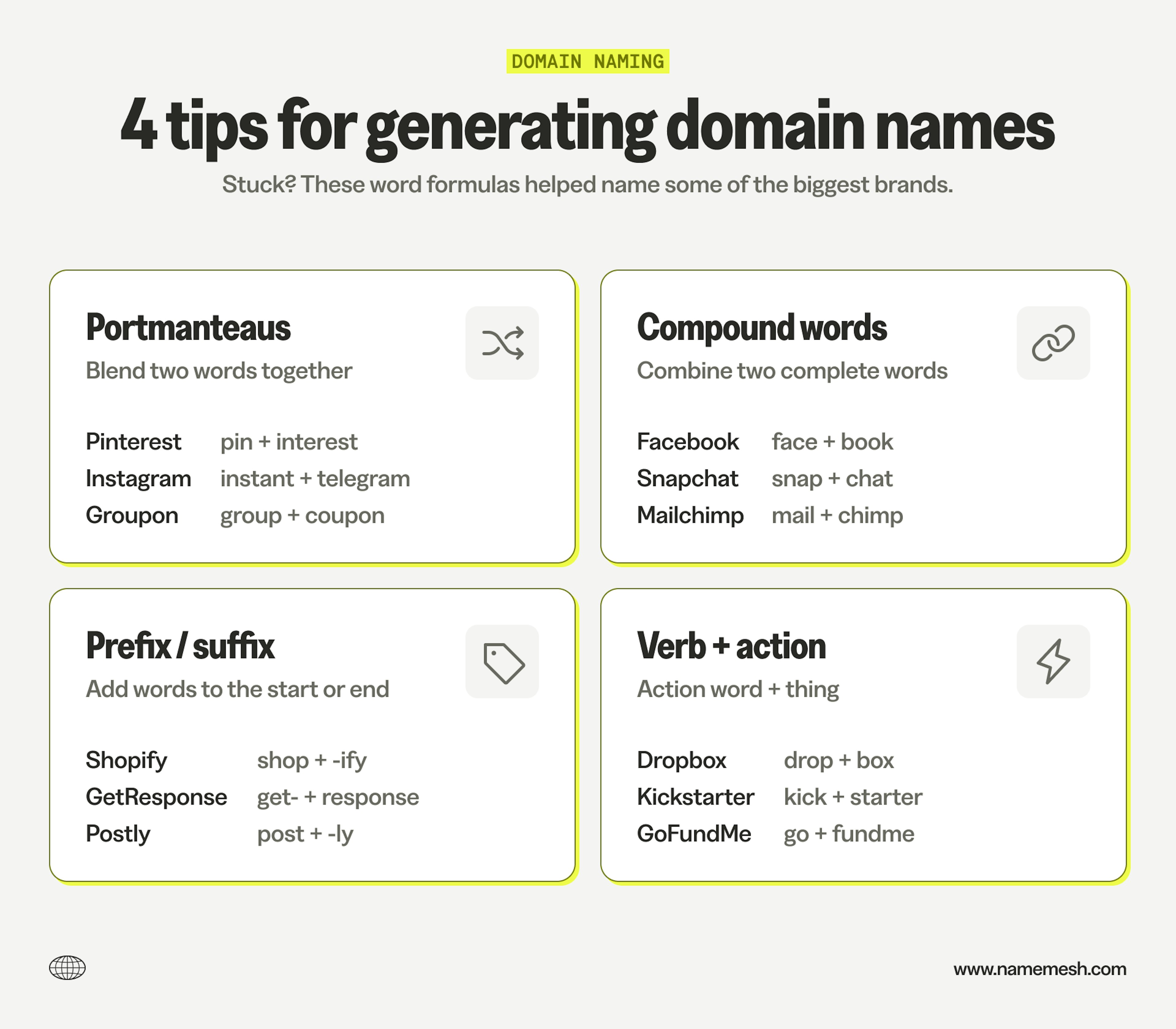
If you try this yourself, keep in mind the name should still pass the radio test we talked about in our previous guide. If you have to explain it, you’ve gone too far toward keyword territory.
Want to explore word combination techniques? Our guide to naming patterns covers portmanteaus, compounds, and prefix/suffix strategies in more detail.
How to decide
Here are a few recommendations based on common scenarios:
- Local service business. A keyword domain can work if you’re serving one area with one service. But go brandable (hybrid is fine) if word-of-mouth is important.
- Software or app. Brandable, almost always. Consider the hybrid approach if there’s one keyword that defines your category (say, “data” or “automation”).
- Content or affiliate site. Either can work, but I’d lean brandable as AI tools increasingly drive traffic based on brand recognition, not keyword matching.
- Single-purpose tool. Keyword or exact-match. The domain becomes the product description and earns repeat visits through utility.
- Consumer brand or e-commerce. Brandable. You need word-of-mouth, social presence, and emotional connection.
- Not sure yet? Go brandable. A name with room to grow will never hold you back. A keyword domain might.
Common mistakes in selecting a domain name
A few things I’ve seen go wrong that end up costly, and frustrating to fix:
- Starting with a keyword domain and planning to rebrand later. Spending the extra time upfront will save you massive headaches down the line, trust me.
- Going brandable but unpronounceable. Don’t do this; use the hybrid approach or another naming technique (like a portmanteau or prefix/suffix).
- Building on a generic keyword domain in a saturated market. If several competitors use nearly identical names that differ only by extension, users will gravitate to whoever ranks first.
- Choosing a keyword domain because it feels "safer" or “easier.” It may feel lower-risk, but the reality is a strong, unique name has more longevity and more potential for growth.
Taking the next step
If it wasn’t clear already, brandable is almost always the way to go (save for a few niche cases where a keyword domain might work better). Our analysis of 5,500 YC startups backs this up: 87% chose brandable names.
But where keyword domains practically name themselves, brandable domain names require a bit more work. So here are a few resources to help:
- Domain name generator. Quickly find available domains that match your business’ audience and brand style (it’s totally free).
- Industry naming patterns. Explore concrete techniques like portmanteaus, compounds, and prefix/suffix strategies for creating name ideas from scratch.
- Top-level domain (TLD) selection strategy. Go deeper on the .com vs others debate (like .io, .shop, etc) and learn which options work best for different use cases.
Want to check out some examples first? See the full startup case study for what the data reveals about domain trends, TLD choices, and naming patterns.